Budapest Night Photography Guide for Better Shots

 Skip to content
Budapest changes character after sunset. The river catches every light, the bridges become clean graphic lines, and familiar façades take on a cinematic warmth that daytime crowds can hide. This Budapest night photography guide is designed to help you come home with images that feel like your own experience of the city, rather than hurried snapshots taken from the nearest pavement.
The secret is not owning the biggest camera or staying out until the early hours. It is knowing where the light falls, when to arrive, and when to put the camera down for a moment and enjoy the view. A little local planning goes a long way here.
For most visitors, the best window begins roughly 20 to 35 minutes after sunset. Photographers call this the blue hour, although it is really a changing stretch of twilight rather than one fixed moment. The sky retains a rich blue tone while building lights, street lamps and bridge illumination have begun to glow.
This balance gives you detail in both sky and city. Wait until the sky is completely black and a scene can still look dramatic, but bright lamps may become harsh white patches and the building outlines can lose their shape. Arrive at your chosen viewpoint before sunset, set up calmly, and photograph as the colour changes.
The exact time depends on the season. Summer evenings are long and sociable, but popular viewing points can be busy. In late autumn and winter, darkness arrives much earlier, which suits a short city break, and the low light can be beautifully atmospheric. Cold fingers and a faster-draining battery are the trade-off.
The postcard view across the Danube is deservedly popular, but the strongest photographs usually contain more than a lit building in the distance. Look for a foreground that tells the viewer where you were standing: a stone balustrade, a tram line, the curve of a bridge, a person in silhouette, or the reflections beside the river.
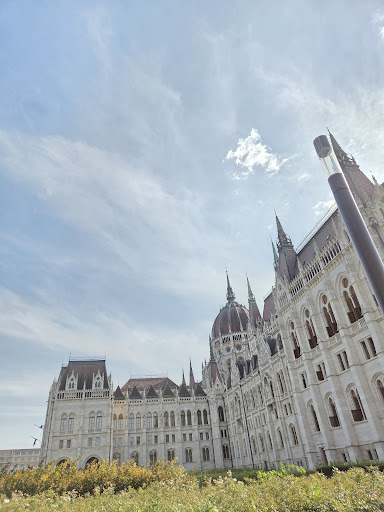
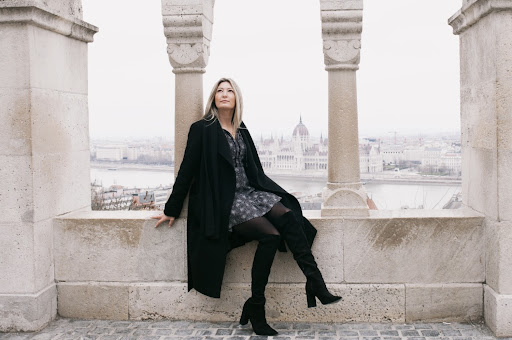
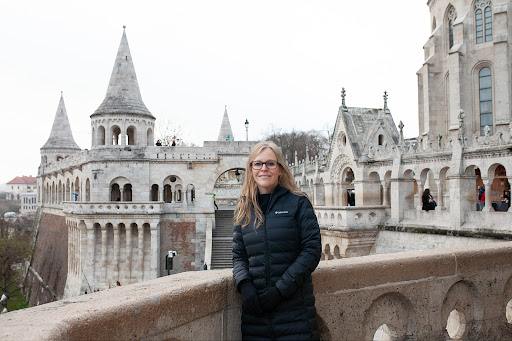
The terraces around Fisherman’s Bastion offer one of the city’s classic night scenes, with the Hungarian Parliament Building glowing across the water. The arches are useful framing devices, especially if you step back and let their pale stone surround the view. A longer focal length can make the building appear larger, while a wider lens gives more context and includes the river below.
This area is rarely empty, so do not wait for a completely clear frame. Instead, use people deliberately. A couple pausing at a viewpoint can add scale and a sense of place. If you are travelling with someone, ask them to stand still for a second or two rather than trying to remove every human presence.
On the Pest side, the riverbank gives you bridge lights, reflections and a direct view towards Buda. Walk rather than stopping at the first obvious spot. A few metres can change whether a lamppost cuts through your subject, whether the water is calm enough for reflections, or whether a passing boat becomes the perfect point of light.
The Chain Bridge is particularly rewarding when photographed from an angle rather than straight on. Let its cables lead the eye into the frame. If a sightseeing boat passes beneath it, a shutter speed of several seconds can turn its lights into elegant trails, but only if your camera is held completely still.
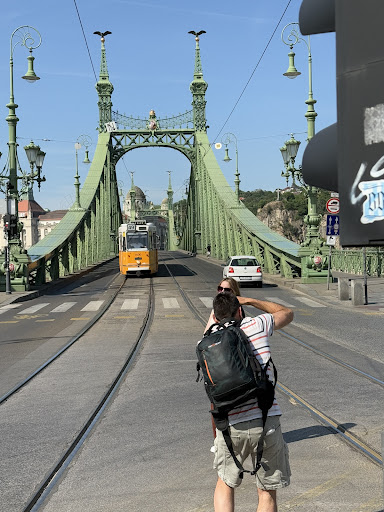
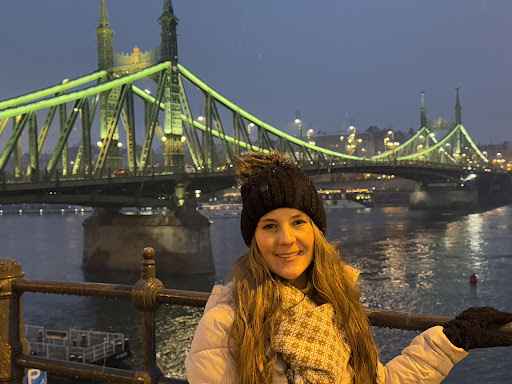
Liberty Bridge has a more intimate, green-lit character and works well in vertical compositions. Nearby streets can be just as rewarding as major viewpoints. Look for pools of warm light, wet cobbles after rain, tram stops, café windows and the small details that make an evening feel lived in.
This is where a compact camera or phone can be more enjoyable than a tripod. You can move freely, respond quickly and avoid turning every picture into a technical exercise.
Night photography does not need to be mysterious. Start by choosing whether you want a hand-held image or a long exposure. That decision determines nearly everything else.
For a hand-held city scene, open the aperture as wide as your lens allows, choose a shutter speed fast enough to avoid camera shake, and raise the ISO only as far as necessary. With a modern camera, ISO 800 to 3200 can be perfectly usable, though every model handles noise differently. If people are in the frame, aim for at least 1/125 second to keep them reasonably sharp.
For a tripod shot of bridges, river views and architecture, keep the ISO low – often ISO 100 – and use an aperture around f/8 for good overall sharpness. Start with a shutter speed of one to five seconds, then check the highlights on your screen. If lamps are losing all detail, shorten the exposure or use exposure compensation.
Phone photographers should use night mode thoughtfully. It can create surprisingly good images when you brace the phone against a railing or hold it very still. Tap on the brightest important area of the frame before taking the picture, then lower the exposure slightly if the lights look blown out. A darker image can often be improved later; blank white highlights cannot.
Whatever camera you use, clean the lens. A fingerprint that is invisible in daylight creates large hazy halos around street lamps at night.
The city is full of beautiful illuminated architecture, but a photograph becomes more memorable when it also captures a feeling. Try shooting through the window of a tram, using a puddle as a reflection, or placing a lone figure against the bright river. These small choices can say more about your evening than another wide skyline.
Look carefully at vertical lines. Tall buildings and bridge towers can appear to lean if you point a wide lens upwards. Sometimes that exaggeration is expressive, but if you want a calmer architectural image, take a few steps back and keep the camera more level. Cropping later is usually preferable to forcing the whole building into the frame.
Do not feel obliged to use a tripod for every shot. A tripod slows you down in a useful way at a viewpoint, yet it can make street photography awkward. It depends on the image you want. For an unplanned street moment, a higher ISO, a wider aperture and a steady hand are often the better tools.
Budapest is easy to enjoy on foot after dark, but sensible preparation keeps your attention where it belongs. Wear shoes with grip, particularly in wet weather or on uneven stone steps, and keep an eye on your bag in busy areas. Carry a spare battery if you use a camera, as cold evenings can drain power sooner than expected.
If you bring a tripod, choose a compact one and avoid blocking paths, viewpoints or entrances. Be respectful around residents, restaurant terraces and other visitors. A quiet set-up and a little patience will get you further than claiming the best spot for half an hour.
Rain is not necessarily a reason to abandon your plans. Light rain deepens the colours of the streets and creates reflections that dry evenings cannot offer. Protect your equipment with a simple cover or umbrella, and wipe the lens regularly. Heavy rain, strong wind and thick fog are another matter, especially at exposed viewpoints, so be flexible rather than chasing a planned shot at all costs.
A good photography evening has breathing room. Pick two or three locations that are close enough to connect on foot, then leave time for the unexpected alleyway, street musician or view that catches your eye on the way. Trying to photograph every famous sight in one night usually means arriving late, feeling rushed and missing the changing light.
For a first evening, begin at a high viewpoint before sunset, make your way down to the river during blue hour, then finish with street scenes once darkness has settled. Check your images only briefly while you are out. A quick look for focus and exposure is useful, but constant reviewing breaks the rhythm of walking and noticing.
If you would rather concentrate on the photographs than navigation, a private photowalk with Budapest Tour Guy can be shaped around your camera, confidence level and the kind of images you enjoy making. The best route for a keen long-exposure photographer is not always the best one for a couple using phones, and that flexibility matters.
Give yourself permission to take fewer frames and stay longer in the places that feel right. The finest night photographs often arrive just after you thought you had finished: when the last blue leaves the sky, a tram turns the corner, and Budapest offers one more moment worth waiting for.
Excellent rating
Based on 156 reviews
 My children and I had a great tour with Gabor. He was very informative and knowledgeable, and also accommodating to my children who had to take many stops due to the heat!
 13 August 2026Gabor took many wonderful family photos for us around the city. We learned more about the culture and history of Budapest during the walking tour. A nice experience. Highly recommended. Good to go early in the morning. It is less crowded in the Fisherman's Castle.+0
 10 August 2026Great tour! Perfect combination of food plus history/cultural information. Definitely recommend!
 15 May 2026Informative and knowledgeable about Hungarian history and culture. Specify your interests and he will adjust the tour accordingly.
 14 May 2026Gabor was a great guide. Very knowledgeable and provided his historical perspective. He was also accommodating - at our request, Gabor incorporate transit into our walking tour to alleviate some of the walking for my older parents. It worked out really well. Thank you!
 6 May 2026I had an amazing photoshoot with Gabor in Budapest! He was incredibly kind, knowledgeable, and accommodating from start to finish. He worked with me on a scheduling change without any stress, picked me up directly from my hotel, and even did an extra shoot there which I really appreciated. Not only are the photos stunning, but he also shared so much history and insight about the city along the way. He helped with poses, and even taught me how to use the tram, which made the rest of my trip so much easier. I'm so happy I did this, it was one of the highlights of my trip!+8
 31 March 2026We had a lovely day with Gabor. He took us around Budapest and we saw some lovely places. Very friendly and knowledgeable.
 15 February 2026My husband and I were fortunate to have Gabor as our guide. He was very professional, patient and made the experience fun. He took us to so many photogenic spots. Got our photos back very quickly. Will do it again if we ever get back to Budapest. Glad we signed up with Gabor.
 30 January 2026Die Fotoshooting-Tour mit Gabor in Budapest war super! Er kennt tolle Spots, schafft eine entspannte Atmosphäre und gibt hilfreiche Tipps vor der Kamera. Die Fotos sind hochwertig und authentisch – absolut empfehlenswert!
 4 January 2026Gabor was a highlight of our cruise stop in Budapest. We were there on the 24th of December and unfortunately many places were closed because of the Christmas holiday. However, Gabor was able to find a few places that we were able to visit to taste local delicacies. It was great having a local perspective and Gabor was a wealth of knowledge. We appreciated Gabor’s hospitality and would highly recommend his tours to anyone visiting Budapest!
 27 December 2025I enjoyed my photography tour with Gabor and especially appreciated his flexibility to meet me at an earlier time. He showed me different photography techniques, hidden areas to capture and allowed me to photograph what I wanted. He was also very knowledgeable with several camera models and shooting settings. I had a lot of fun and I highly recommend it! Thank you Gabor!
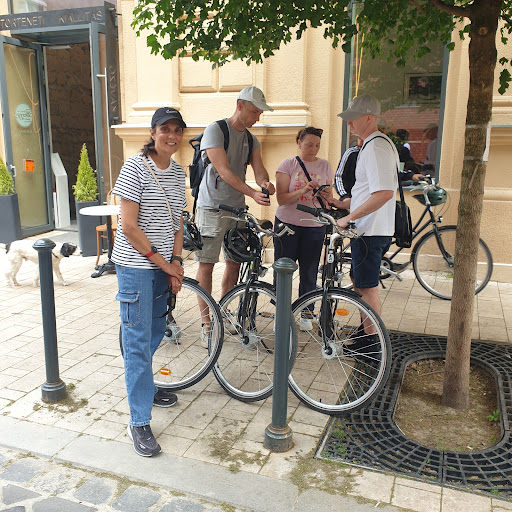
 26 December 2025Gabor is a very friendly and great storyteller with a wealth of historical, cultural and political knowledge! He made our bike tour an amazing experience! Thanks so much Gabor!
 26 December 2025Gabor is so nice and accommodating! Gave us a nice tour of Budapest and took some pictures to remind us of our time there.+1
 24 December 2025We had a wonderful time with Gabor in Budapest! He was very patient with us and knew all the photo spots on both sides of town. We loved hearing about the different buildings and the history of Hungary on our tour.
 22 December 2025Just finished a really nice tour with Gabor via Withlocals. Gabor showed a few nice places to eat which we wpuld never have found by ourselves. Big thumbs up for Gabor!
 10 December 2025I cant recommend Gabor enough. Have an amazing afternoon strolling around Budapest Landmarks and got Gabot to catch my moment there. He’s so talented and have learnt so much from him about Budapest/Hungary history. Got to catch tram and buses for the first time in Busapest. Thank you for such an amazing time.
 4 December 2025Great experience - we learned a great deal about Hungary’s history and culture!
 26 October 2025So knowledgeable. So personable. Would highly recommend. Learned about the history of not just Budapest but Hungary as a whole.
 1 October 2025We had an amazing experience with Gabor. He was friendly, calm and professional. He took us to many places to get lots of different landmarks and poses. He also gave us a very big selection of pictures. If he is still available, book him.
 27 August 2025Gabor is a wonderful, popular guide. My wife and I thoroughly enjoyed our 2 days with him and highly recommend using him as a guide in Budapest. He has excellent english and very wide knowledge of Hungarian history and art and architecture.
 14 August 2025Excellent tour guide … It rained that 2 pm when we were about to start but did not deter him at all .. nobody booked that day except my wife and I needless to say a very private tour for us.. he showed us all the beautiful a nd historic sites in Budapest.. we walked, rode the subway and the tram.. we have a very nice coffee and strudel break.. his recommendations for poppy seed strudel is the best.. Very educated not only History of Budapest, Europe but also beyond.. Thanks to him and we went home with a lot of memories of Budapest.. If there is a six star, I would definitely give to him .. I would use him again next year when we go back with the family … definitely recommend him to anyone who wants a full experience.. he also does photography tour..
 9 July 2025My husband and I both enjoyed our private walking tour. Gabor was a wealth of historical insight into Budapest's history. He was also friendly and flexible.
 23 June 2025Thanks Gabor! You are amazing person with full of knowledge of Budapest. We had great walking tour covering both Buda and Pest sides in 4 hours time using very efficient local transport of Budapest. 🤗+0
 22 June 2025My photographer was very professional and patient because mom cannot walk too much. We had a great time and enjoyed the history he told. Very informative. I would recommend him.
 7 June 2025Gabor was wonderful! If I could I would give him 10 stars!! Highly recommend!!! 7am is early but if you want to get pictures without a ton of people around, it’s the only way to do it! Gabor was kind, professional and patient! Thank you Gabor!+0
 1 June 2025Gabor did a great job taking pictures of our family! He is Highly recommended!!
 1 June 2025Gabor gave an excellent overview of a few areas around Budapest. Learned lots of history and interesting facts about this dynamic city.
 25 May 2025Gavor was extremely knowledgeable and informative and a great host. Highly recommend doing the bike tour with him. Shane from Australia+0
 3 May 2025Gabor is a fantastic photographer... He is very professional and had great time finding nice spots with history behind the locations. Great memories I have of my time in Budapest... Totally worth it... Thank you again Gabor !!!
 2 May 2025Excellent experience! I do not like having my picture taken and was very nervous. Gabor made me feel comfortable. I would highly recommend him to anyone looking for a good photographer.
 18 January 2025Gabor is the best guide to Budapest- he will make your trip unforgettable with his knowledge, kindness and humour!+1
 12 January 2025I did a shoot with my cat and Gabor made it amazing. His pics are top quality, and the result is superb! He’s also a walking traveling book. If you want a special experience when you are in Budapest, book him …. You’ll love it!
 4 January 2025We couldn't be happier by hiring Gabor to capture the precious moment for our family in Budapest. Gabor is not only a great photographer but also a knowledgeable tour guide who taught us so much about the history of Budapest and Hungary. He is very flexible to work with and I really appreciate that even our reserved time is up, he didn't rush to finish the session and spent another hour just to hit the spots that he intended to take our pictures. Although we are not in a rush, he worked so hard to send us the edited pictures in less than 48 hours which was amazing. I felt that I didn't only find a good photographer and tour guide, but also made a good friend in Hungary. Highly recommended!!!
 29 December 2024We were visiting from Sydney for a five day visit to Budapest. Gabor is an amazing tour guide. We wanted a locally connected tour guide and he was certainly that! He was easy going, relaxed, a thorough historian who spoke excellent English. We walked and talked around for more than 3 very interesting & entertaining hours exploring Budapest visiting: * Heroes Square (Hősök tere), * the Museum & Library of Hungarian Agriculture (Magyar Mezőgazdasági Múzeum és Könyvtár) * Magyar Mezőgazdasági Múzeum és Könyvtár * St. Stephen’s Basilica * Buda Castle Precinct * Reteshav, Strudel House….first & best strudel in Budapest At the end of our tour, we were reluctant to leave him to go on our next walking food tour and invited him to come along with us 🥹 but he kindly refused. Even after our tour, he was helping us with recommendations via texts for dinner venues, which were excellent choices. Give Gabor a call, he will tailor a bespoke and personalised Budapest tour for you that won’t cost the earth. You won’t be disappointed!
 28 December 2024the walking tour with Gabor was the best! i learned so much about Buda and Pest and really enjoyed the sights. Gabor was great about tailoring the tour to my interests/questions. a MUST DO in budapest!
 26 December 2024Gabor is definitely worth booking for the sightseeing tour. He is very knowledgable about Budapest/Hungarian history. He is willing to adjust with what his guests want during the tour. We chose a photo-centric tour and he knows alot of good spots to take photos whether a postcard material shot or your portrait on the most interesting spots in Budapest. It’s also a plus that he has got a good sense of humor. Thank you Gabor, we enjoyed the tour alot. Henyr, Winnie
 21 December 2024Loved the walking tour. Very adaptive to our interests and what we wanted to do and see. Good history lesson and good conversations about almost everything. Loved the appel and poppy seed strudel!+1
 6 December 2024Great walking tour. Very informative and educational guide! Enjoyed the sights and the apple strudel.+2
 6 December 2024
Select cookies
Cookies are small text files that the web server stores on your computer when you visit the website.
These cookies cannot be disabled. They are required for the website to work.
To improve the website, including information and functionality, we want to collect analytics. We cannot identify you personally using this data.
By sharing your browsing behavior on our website we can serve you personalized content and offers.
These cookies enable advanced website features such as video playback, chat or embedded content.